
The Age of the Sophists

Preamble

If honest and competent, a lifelong student of world history would observe that as free civic polities become decadent, those, claiming some intellectual, or at least rhetorical, prowess become largely sophists. Herein, an overwhelming number of public “thinkers” argue from both sides of their arse in order to advance a factional/sectarian cause. Other sophists prostitute their rhetorical prowess on behalf of whatever paymaster by whom they are paid.

Public disdain for the sophists, attested by the three famous philosophers of Athens, undermines respect for all intelligentsia, the life of mind, and meaningful public discourse required for the survival and welfare of any free civic polity.

The American Republic has befallen into a cesspool of sophistry, this even before the Donald rode the down escalator to declare his candidacy for President in the summer of 2015. This dissembling is largely consequent of a decades-long kulturkampf.

Sophists have existed in all societies. The age of sophists, however, occurs only when the mendacity and the sophistry becomes pervasive and prevailing. The meretricious claims are so sweeping in breadth that the debunkers cannot keep up.

In healthy societies, specious claims and arguments are derided and condemned by those from one’s own faction, this for the sake of continued credibility of one’s own faction.  Consider William Buckley Jr.’s denouncing of Ayn Rand, the John Birch society, and other racialists and antisemites. Herein, self-interest is enlightened and tempered with principle.

Nowadays, there are pundits who shamelessly shed impartiality, ostensibly because perfect impartiality is humanly impossible, and thereupon openly declare themselves “advocacy journalists,” sophists by another label.

Et tu, Mollie Hemingway

One of my egregious mistakes has been in giving respect and ear to journalistic pundits in America who, while their faction is in opposition, poignantly refuted and deprecated the claims and arguments of their sociopolitical foes. These pundits, while in opposition, often wrapped themselves in moral/ethical principle, even in the particulars of the American Constitution. But once their faction mounts the Commanding Heights of society, moral/ethical principle and constitutional niceties are quickly and unceremoniously set aside. Both factions are guilty of this inconsistency and hypocrisy.

There were a number of conservative pundits, who I followed to varying degrees during the Biden administration, who declaimed the follies and vices, even the ever increasing insanities of the extremism, currently and preemptively labeled Woke 1.0, (preemptive in the belief that like Trump 2.0, a worse rendition shall imminently return).

Mollie Hemingway was one of an ever diminishing periphery of journalistic pundits in America worthy, so I thought, of giving an ear. I might have missed the tidbit about how she had drunken the Kool-Aid. For in a recent video quip, she defends the indefensible.

In light of imminent shortages and spikes in diesel prices, Donald Trump has now defied the spirit of a law, yet to be put in legal force, that he signed off on just last month, which sanctioned the purchase of Russian energy products. In Lindsey Graham’s Sanctioning Russia and Iran Act, the President was even given leeway to levy steep tariffs on other countries who bought oil products from those identified. Indeed, Trump threatened to do so with India last month.

In light of Ukraine’s ability to attack refineries throughout Russia, even cripple the Baltic ports, which are portals from where diesel might be exported, the Black Sea behind completely untenable, this presidential waiver is insignificant in impact, but rich in significance.

Hemingway, now a converted Trumpian sycophant, defends his actions:

Well, the legislation mentioned does include a provision that the president can work within the restrictions of the sanctions. But I think what President Trump is trying to do here is put the American people first and let them have an interest in this ongoing, lengthy war between Russia and Ukraine. People in America are suffering. Farmers in Nebraska, Kansas, and Iowa who are dealing with very high diesel prices. Just normal Americans who are struggling to fill up their tanks at the pump. And diesel is something that Russia has a lot of.

Hemingway notes that America is not “actually at war with Russia, and that America has given Ukraine hundreds of billions of dollars. We provide the technology, weapons, intelligence, and we’re happy to do that in their efforts.”

The notion of aiding Ukraine, but then aiding Russia, in their interminable war efforts might be deemed as acting at cross-purposes, an epithet ascribed to the conflicting purposes of the policies in Jimmy Carter’s administration.
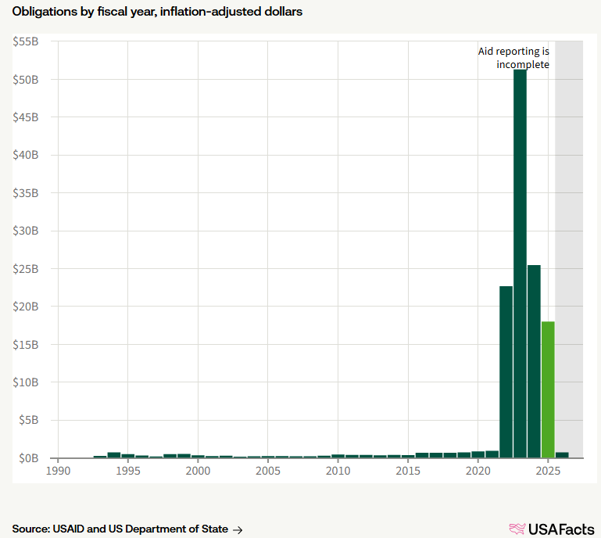
Aid for Ukraine might have been the case. But as of September 29, 2026, Trump has effectively cut off economic and military aid to Ukraine, now more explicitly by not permitting the use American assets (intelligence and satellite links), tilting the advantage to Putin’s Russia.

Cutting off subsidiary support to Ukraine’s war efforts is particularly rich, coming from a President who recently complained about allies who refused to grant access to their air bases and space for planes destined for aggressive operations in Trump’s war of choice with Iran.

And complaints of economic hardship in rich America in comparison to the existential crisis in Ukraine are akin to a family member who, whenever someone related some trauma that they have and/or are now undergoing, claims that her “hardships” are of similar kind and degree. She has lost all contact with her family who cannot stomach her intractable narcissism.

Unenlightened Self-Interest

It is naïve to believe that common humanity acts in anything but self-interest. Undergirding America’s magnanimity after World War II (i.e. Marshall Plan) were geopolitical and economic calculations. Nevertheless, the beneficiaries of such enlightened self-interest have little basis to complain about American motives.

But under Trump, America has formally renounced a first among equals foreign policy in favor of raw and myopic self-interest and self-aggrandizement. In so doing, and in its resentment of allies, who failed to carry their burden as they recovered from the devastation of WW2, America has permanently forfeited its moral authority and role in dictating how the world is run.

Europeans, who have long longed to unburden themselves of the shackles of American hegemony but did not have the political will and courage to do so, have recently discovered their kahunas or, at least, one of them in their resistance to Trump’s feint to invade Greenland. They, who have long basked in safety and prosperity, but have not been prepared to own responsibility for that security and prosperity, are being thrown to the wolves by Trump’s America.

The population of the European Union is 452 million, excluding Britain; 522 million with it. The nominal GDP of the EU is 21.24T USD, excluding Britain; 25.26T USD, including it. The GDP of the EU and Britain, under a PPI variant (Producer Price Index), exceeds that of the US. For Russia, the numbers are 140.1 million, 2.56T USD, and 7.24 USD respectively.

The Europeans are rearming. How much of a threat is Russia to Europe once Europe has rearmed? And after rearmament, Europe shall no longer have need for American military support and the American dollar as the reigning Reserved Currency. Moreover, Europe will emerge as another independent geopolitical power, another rival to American interests.

Canada has also reneged on its military responsibilities, largely courtesy of Trudeau Jr. and the specter of Trudeau Sr. A society unwilling to defend its sovereignty is unworthy of retaining its sovereignty. Hence, Canada is also rearming. Carney is committed to building millions of drones. I have since 2017 believed that Canada needs WMDs, 500 nuclear bombs, 5,000 dirty bombs should do the trick.

Americans may resent being the erstwhile defenders of Canada, and may ridicule the phantom military that it currently has. However, which is preferable from the view of American enlightened self-interest: a freeloading nation to their north and an undefended border, or one armed with drones and nuclear tips?

Sudetenland Reprised

Americans, including Hemingway, have a low threshold for inconvenience, let alone real suffering. The whole world knows this. Iran’s strategy of patience in its current war with America operates upon this premise. And certainly, Russia’s Putin knows this. The Russians have rarely had good commanders. They count on attrition and the grating willingness of the Russian people to be cannon fodder. The Rus did not build their empire overnight.

Putin will not negotiate peace unless he retains what his military has currently acquired. His political survival and legacy requires such a “peace.” The only way that the Russians might negotiate with lesser gains is if Putin dies and a new Tsar ends the war in order to stop the bleeding of Russians in an interminable war of attrition, worse than Afghanistan.

But from the perspective of Zelensky’s Ukraine, the eastern regions with a sizable ethnic Russian populace, are equivalent to Czechoslovakia’s Sudetenland, which was also populated with a large number of Germans. Hitler annexed the Sudetenland in September of 1938, courtesy of the complicity of  Neville Chamberlain. Germany took the rest of Czechoslovakia six months thereafter, also without military confrontation with western powers which had made a defense pact with Czechoslovakia.

The Americans can no longer be trusted to keep faith with their treaty promises. And Ukraine cannot count on the Europeans unless and until it becomes a proper formal member of the EU. War is hell, except for the alternatives.

And just like Viet Nam, wherein a peace settlement in 1972 allowed Nixon to completely extricate America from the South, allowing the latter’s conquest, any peace settlement with Russia would facilitate a similar concession, although it now appears, under Trump, a peace settlement is no longer required in order for the Americans to again renege.

Once upon a time, the Americans, whether Republicans or Democrats, understood that violating their promises contained in treaties in one jurisdiction would only invite further aggressions by hostile actors, alternative arrangements for allies, and the diminishment of American geopolitical power and influence. But that was a different generation.

Frasier Institute and Biased Analysis

There presently exists a defining political disagreement in Canada between those who ache to retain Continentalism at all costs (re: Poilievre’s Conservatives) and those who perceive an irreparable and enduring rupture in trade relations between Canada and the USA (re: Carney’s Liberals). It makes for a more engaging politics than the typical pedestrian muddle.

In response to this ruptured understanding, Carney proposed to restructure the economy in October 2025, such that annual trade and services exports to non-American destinations would increase by $300B in ten years, nominally doubling from the current amount. Conservative pundits, relying upon a recent Fraser Report, itself a financially conservative and pro-American think tank, think “Mark Carney’s non-U.S. exports target far-fetched.”

Doubling non-US exports in ten years might seem like a pipedream if one does not consider compound interest. This target is merely 7.2% annual growth nominally. After accounting for 2% inflation, based upon government and central banker targets, this is merely a 5.1% increase annually.

The Fraser Report notes (p.2), “Canada’s merchandise exports to the United States jumped from $108 billion in 1988 to $206 billion by 1995, almost doubling (in nominal dollar terms) within the span of seven years.” The services component of Canadian exports more than doubled between 2014 and 2024 (March 2014: $9.235B; March 2024: $20.587).

Hence, I hardly think that this target is improbable and merely aspirational. Indeed, I suspect that Carney may have understated the likelihood. But let history be the true judge of such punditry, and let us then stone false prophets (LOL).

The Fraser Institute Fallacy

The Fraser Report’s claims are largely based upon the fallacy of what has been shall ever continue to be, facilitated by geographical proximity which reduce transportation costs, common language, and similar legal standards and business practices (p.3).

On the basis of trade patterns between 1999 and 2024, the Report found that “the total share of goods exported to the U.S. from Canada decreased only modestly, from 86.7% in 1999 to 76.3% in 2024.” This does not include services, in which presently the US share is only 50.2% ($109.3B out of $217.8B). In 2023, the US share was 53.2%, slightly higher in the years prior.

The Fraser Report does not “identify and evaluate policy measures that might reduce Canada’s high degree of trade dependence on the United States, particularly as an export market” (p.1). Considering that on both sides of the border, policy measures have already been and likely will continue to be instituted, which will reduce Canadian exports to the US, it makes the value of this Report dubious, at best.

For already, the US share of total merchandise exports has declined from 79.5% (Feb 2025), when Trump began his tariff campaign, to 66.4% in February 2024, this before the Iran War. (The higher than normal February 2025 share was extra loaded in anticipation of the coming tariff regime.) In this time, however, total merchandise exports to other non-American destinations increased from $14.3B (Feb 2025) to $22.3B (Feb 2026) on a monthly basis, a 50+ percent increase, consistent with a growing pattern in the last year. This growth, it must be admitted, is but low hanging fruit of any diversification efforts.


The Fraser Report and conservative pundits point out that Canadian governments have made periodic feints to diversify our trade patterns for 50 years (i.e. Trudeau Sr., Chretien) without much avail. But these seemed half hearted attempts to me at the time, especially compared to what Carney has achieved in this last year.

A smoker may know that his/her habit is detrimental to health and life all throughout life and make periodic feints to quit. But only when an X-Ray comes back, showing a tumor, might that smoker have serious resolve to quit. The peril of having over 20% of Canadian GDP dependent upon US exports has long been well known. But the Americans, until the last decade or two, operated upon a “first among equals” geopolitical principle. All allies benefit, even if America benefitted most by its rules-based liberal order. Consequently, allies became all too comfortable under their prosperous semi-vassalage to the U.S.  

But when a geopolitical superpower feels its real loss of relative power and influence, it becomes less magnanimous, moving away from enlightened to unenlightened self interest, becoming self-serving and self-aggrandizing, duplicitous, even evil. Our own short Canadian history is witness to this dynamic of decadence with regard to the British Empire, the first to introduce concentration camps in the Boer War, making false promises to both Jews and Arabs during WW1, while conspiring to carve up the Middle East with France. Canadian and ANZAC abhorrence at the way the British conducted WW1, to which our semi-vassal states were subject, instigated further autonomy away from the UK (i.e. The Statute of Westminster, 1931).

Inadvertent Advantages of Still Being Hewers of Wood

Another analyst at the Fraser Institute, an American who works for the American right-wing think tank, Cato Institute, bemoans the natural cause-and-effect consequence of Trump’s tariff regime to American fortunes.

Yet the 50 per cent tariff and removal of the Canadian exemption in 2025 pushed major Canadian producers to divert exports to Europe. Aluminerie Alouette, North America’s largest smelter, shifted its European sales from 4 per cent to 57 per cent of production in a matter of months. Rio Tinto stopped selling in the U.S., and even Alcoa reduced cross-border shipments. The troubling consequence of this shift was increased U.S. reliance on Middle Eastern suppliers—the UAE and Bahrain together accounted for nearly one-quarter of U.S. unwrought aluminum imports—but these sources have now been disrupted because of the Iran conflict. With global demand for non-Gulf aluminum sky-high and Canadian smelters operating at full utilization, there’s little chance producers in Canada will redirect back to U.S. buyers in the near term.

Relevant to Canadian concerns, be damned American self-interest, the remarkable thing is how quickly Canadian aluminum companies, even one owned by Americans, could switch clients so quickly. Considering how wildly variable, US trade policies presently are and will continue to be for at least another 30 months, even this American understands that Canadian producers will not be soon returning to the US.

The advantage of still being a resource economy, at least from the perspective of exports, is that the market is global. If global supply and demand are in rough equilibrium, then the actions of one self-serving actor merely shifts trading patterns. This is not so true with other trade goods and services.

Commodities and refined commodities constitute about 40% of all Canadian merchandise exports. Build a few pipelines, even Canada’s greatest export type can be diverted from the US to new customers. Europeans are most willing to replace unstable Persian Gulf sources, for instance, with more secure and stabler Canadian sources, especially if it becomes coupled with defense contracts that replace American military contractors. Everybody wins but the Americans who are not at the table.

Conservatives in the Wilderness

Poilievre’s Conservatives would probably be competent managers of the nation in the style of Stephen Harper, certainly heads and shoulders above the inconsequential fop, Justin Trudeau. However, in the depths of their heart, Continentalist Conservatives still perceive that America is now what it was 50 years ago. Canadians could then go to Washington, placate American concerns, plea for amendments or exemptions, which it more or less acquired.

This is certainly not true of Trump’s America, which weaponizes its sizeable power and leverage, extorts its trading partners while deploying the lamest of pretenses, and openly humiliates those trading partners which they have just extorted. I do not believe, going forward, that American hubris will differ in kind after Trump, just in degree. America is not now the America that we knew in our youth.

Canadians, it seems, have no appetite for a semi-vassalage that is openly exploitative. They just might be willing to suffer a period of sacrifice while the nation undergoes necessary restructuring of its economic, military, diplomatic, and foreign policy to meet new realities.

This might also be Canada’s maîtres chez nous moment. Canada might have weaned off mother Britain after the First World War. But it seems that Canada merely began to suckle at the breast of America instead. Those breasts are drying up. There just might be a youthful appetite in this country to finally strike it on our own, to get out from under the shadow of the American Woman.

Poilievre and the whole conservative movement is behind the curve on this political development against one who is a conviction politician, a most unusual anomaly within a party whose only conviction has hitherto been to govern for its own sake.

They are losing my family of cultural, yet politically moderate, conservatives. They are losing me, who has never before voted left of center. For Carney’s Liberals are doing the very thing I proposed back in 2017, having been fully aware of the American zeitgeist at that time.   

Roughly seventy-five percent of our exports go to the United States, constituting almost thirty percent of our economy. If there be economic disruption, whether because of social/civic or economic causes, those exports, just like happened in the aftermath of the 2008/9 Great Recession (re: a 25% decline), will be inordinately affected. Should not the diversification of our trade become first and overriding priority, especially with an American administration devoted to a Realpolitik bullying of other nations into a regime of permanent economic advantage for the United States? (Even apart from the present politicos, the existential economic sclerosis in the United States will incline them to increasing self-serving and myopic trade policy).

Pipelines, both east and west, must be approved; not because there are not environmental dangers and detriments to carbon-based energy; but because the welfare of the nation is dependent upon more than just one aspect of life. Oil and natural gas should be used as a trade lever (through long-term guaranteed supply) to open up foreign markets which are effectively closed through tariff and non-tariff barriers. An activist inculcation of extensive balanced trade deals with other nations of similar economic status should be pursued.

The goal should be the reduction of our exports to the United States to considerably less than 50% of total exports, not only for economic reasons of safety, but to reduce any threat to political autonomy by a more bullying American foreign and trade posture. There will be disruption. There will likely be economic loss, at least in the interim. However, such is the need for inoculation to make us less vulnerable to the most likely outbreak of American disease.

While we are thinking of the unthinkable; because America is showing itself to be a less reliable defense partner, and because conflict in the United States may induce military incursions into our country, we may need to acquire our own weapons of mass deterrence.