
Preamble
If honest and competent, a lifelong student of world history would observe that as free civic polities become decadent, those, claiming some intellectual, or at least rhetorical, prowess become largely sophists. Herein, an overwhelming number of public “thinkers” argue from both sides of their arse in order to advance a factional/sectarian cause. Other sophists prostitute their rhetorical prowess on behalf of whatever paymaster by whom they are paid.
Public disdain for the sophists, attested by the three famous philosophers of Athens, undermines respect for all intelligentsia, the life of mind, and meaningful public discourse required for the survival and welfare of any free civic polity.
The American Republic has befallen into a cesspool of sophistry, this even before the Donald rode the down escalator to declare his candidacy for President in the summer of 2015. This dissembling is largely consequent of a decades-long kulturkampf.
Sophists have existed in all societies. The age of sophists, however, occurs only when the mendacity and the sophistry becomes pervasive and prevailing. The meretricious claims are so sweeping in breadth that the debunkers cannot keep up.
In healthy societies, specious claims and arguments are derided and condemned by those from one’s own faction, this for the sake of continued credibility of one’s own faction. Consider William Buckley Jr.’s denouncing of Ayn Rand, the John Birch society, and other racialists and antisemites. Herein, self-interest is enlightened and tempered with principle.
Nowadays, there are pundits who shamelessly shed impartiality, ostensibly because perfect impartiality is humanly impossible, and thereupon openly declare themselves “advocacy journalists,” sophists by another label.
Et tu, Mollie Hemingway
One of my egregious mistakes has been in giving respect and ear to journalistic pundits in America who, while their faction is in opposition, poignantly refuted and deprecated the claims and arguments of their sociopolitical foes. These pundits, while in opposition, often wrapped themselves in moral/ethical principle, even in the particulars of the American Constitution. But once their faction mounts the Commanding Heights of society, moral/ethical principle and constitutional niceties are quickly and unceremoniously set aside. Both factions are guilty of this inconsistency and hypocrisy.
There were a number of conservative pundits, who I followed to varying degrees during the Biden administration, who declaimed the follies and vices, even the ever increasing insanities of the extremism, currently and preemptively labeled Woke 1.0, (preemptive in the belief that like Trump 2.0, a worse rendition shall imminently return).
Mollie Hemingway was one of an ever diminishing periphery of journalistic pundits in America worthy, so I thought, of giving an ear. I might have missed the tidbit about how she had drunken the Kool-Aid. For in a recent video quip, she defends the indefensible.
In light of imminent shortages and spikes in diesel prices, Donald Trump has now defied the spirit of a law, yet to be put in legal force, that he signed off on just last month, which sanctioned the purchase of Russian energy products. In Lindsey Graham’s Sanctioning Russia and Iran Act, the President was even given leeway to levy steep tariffs on other countries who bought oil products from those identified. Indeed, Trump threatened to do so with India last month.
In light of Ukraine’s ability to attack refineries throughout Russia, even cripple the Baltic ports, which are portals from where diesel might be exported, the Black Sea behind completely untenable, this presidential waiver is insignificant in impact, but rich in significance.
Hemingway, now a converted Trumpian sycophant, defends his actions:
Well, the legislation mentioned does include a provision that the president can work within the restrictions of the sanctions. But I think what President Trump is trying to do here is put the American people first and let them have an interest in this ongoing, lengthy war between Russia and Ukraine. People in America are suffering. Farmers in Nebraska, Kansas, and Iowa who are dealing with very high diesel prices. Just normal Americans who are struggling to fill up their tanks at the pump. And diesel is something that Russia has a lot of.
Hemingway notes that America is not “actually at war with Russia, and that America has given Ukraine hundreds of billions of dollars. We provide the technology, weapons, intelligence, and we’re happy to do that in their efforts.”
The notion of aiding Ukraine, but then aiding Russia, in their interminable war efforts might be deemed as acting at cross-purposes, an epithet ascribed to the conflicting purposes of the policies in Jimmy Carter’s administration.
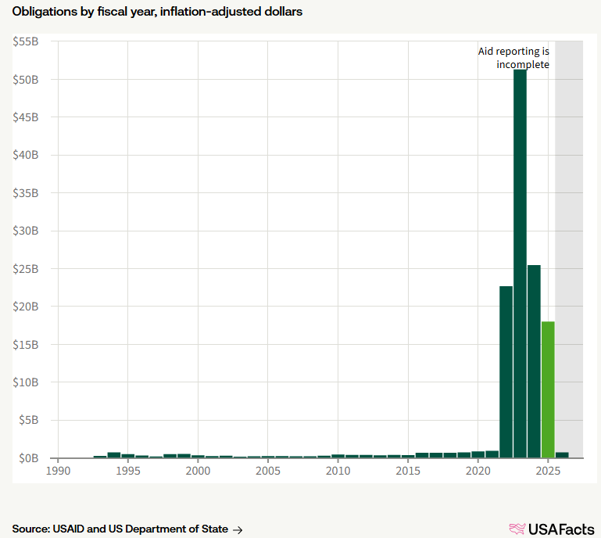
Aid for Ukraine might have been the case. But as of September 29, 2026, Trump has effectively cut off economic and military aid to Ukraine, now more explicitly by not permitting the use American assets (intelligence and satellite links), tilting the advantage to Putin’s Russia.
Cutting off subsidiary support to Ukraine’s war efforts is particularly rich, coming from a President who recently complained about allies who refused to grant access to their air bases and space for planes destined for aggressive operations in Trump’s war of choice with Iran.
And complaints of economic hardship in rich America in comparison to the existential crisis in Ukraine are akin to a family member who, whenever someone related some trauma that they have and/or are now undergoing, claims that her “hardships” are of similar kind and degree. She has lost all contact with her family who cannot stomach her intractable narcissism.
Unenlightened Self-Interest
It is naïve to believe that common humanity acts in anything but self-interest. Undergirding America’s magnanimity after World War II (i.e. Marshall Plan) were geopolitical and economic calculations. Nevertheless, the beneficiaries of such enlightened self-interest have little basis to complain about American motives.
But under Trump, America has formally renounced a first among equals foreign policy in favor of raw and myopic self-interest and self-aggrandizement. In so doing, and in its resentment of allies, who failed to carry their burden as they recovered from the devastation of WW2, America has permanently forfeited its moral authority and role in dictating how the world is run.
Europeans, who have long longed to unburden themselves of the shackles of American hegemony but did not have the political will and courage to do so, have recently discovered their kahunas or, at least, one of them in their resistance to Trump’s feint to invade Greenland. They, who have long basked in safety and prosperity, but have not been prepared to own responsibility for that security and prosperity, are being thrown to the wolves by Trump’s America.
The population of the European Union is 452 million, excluding Britain; 522 million with it. The nominal GDP of the EU is 21.24T USD, excluding Britain; 25.26T USD, including it. The GDP of the EU and Britain, under a PPI variant (Producer Price Index), exceeds that of the US. For Russia, the numbers are 140.1 million, 2.56T USD, and 7.24 USD respectively.
The Europeans are rearming. How much of a threat is Russia to Europe once Europe has rearmed? And after rearmament, Europe shall no longer have need for American military support and the American dollar as the reigning Reserved Currency. Moreover, Europe will emerge as another independent geopolitical power, another rival to American interests.
Canada has also reneged on its military responsibilities, largely courtesy of Trudeau Jr. and the specter of Trudeau Sr. A society unwilling to defend its sovereignty is unworthy of retaining its sovereignty. Hence, Canada is also rearming. Carney is committed to building millions of drones. I have since 2017 believed that Canada needs WMDs, 500 nuclear bombs, 5,000 dirty bombs should do the trick.
Americans may resent being the erstwhile defenders of Canada, and may ridicule the phantom military that it currently has. However, which is preferable from the view of American enlightened self-interest: a freeloading nation to their north and an undefended border, or one armed with drones and nuclear tips?
Sudetenland Reprised
Americans, including Hemingway, have a low threshold for inconvenience, let alone real suffering. The whole world knows this. Iran’s strategy of patience in its current war with America operates upon this premise. And certainly, Russia’s Putin knows this. The Russians have rarely had good commanders. They count on attrition and the grating willingness of the Russian people to be cannon fodder. The Rus did not build their empire overnight.
Putin will not negotiate peace unless he retains what his military has currently acquired. His political survival and legacy requires such a “peace.” The only way that the Russians might negotiate with lesser gains is if Putin dies and a new Tsar ends the war in order to stop the bleeding of Russians in an interminable war of attrition, worse than Afghanistan.
But from the perspective of Zelensky’s Ukraine, the eastern regions with a sizable ethnic Russian populace, are equivalent to Czechoslovakia’s Sudetenland, which was also populated with a large number of Germans. Hitler annexed the Sudetenland in September of 1938, courtesy of the complicity of Neville Chamberlain. Germany took the rest of Czechoslovakia six months thereafter, also without military confrontation with western powers which had made a defense pact with Czechoslovakia.
The Americans can no longer be trusted to keep faith with their treaty promises. And Ukraine cannot count on the Europeans unless and until it becomes a proper formal member of the EU. War is hell, except for the alternatives.
And just like Viet Nam, wherein a peace settlement in 1972 allowed Nixon to completely extricate America from the South, allowing the latter’s conquest, any peace settlement with Russia would facilitate a similar concession, although it now appears, under Trump, a peace settlement is no longer required in order for the Americans to again renege.
Once upon a time, the Americans, whether Republicans or Democrats, understood that violating their promises contained in treaties in one jurisdiction would only invite further aggressions by hostile actors, alternative arrangements for allies, and the diminishment of American geopolitical power and influence. But that was a different generation.